

Sometimes you know what you wanted to say, but anger takes over before you can say it clearly. Afterwards, the original concern is still there, alongside regret about how the conversation went.
Anger-management tools can help you recognise what is happening and choose a more helpful response. If you have ADHD, you may also need support to remember the tool, use it early enough and return to the issue afterwards.
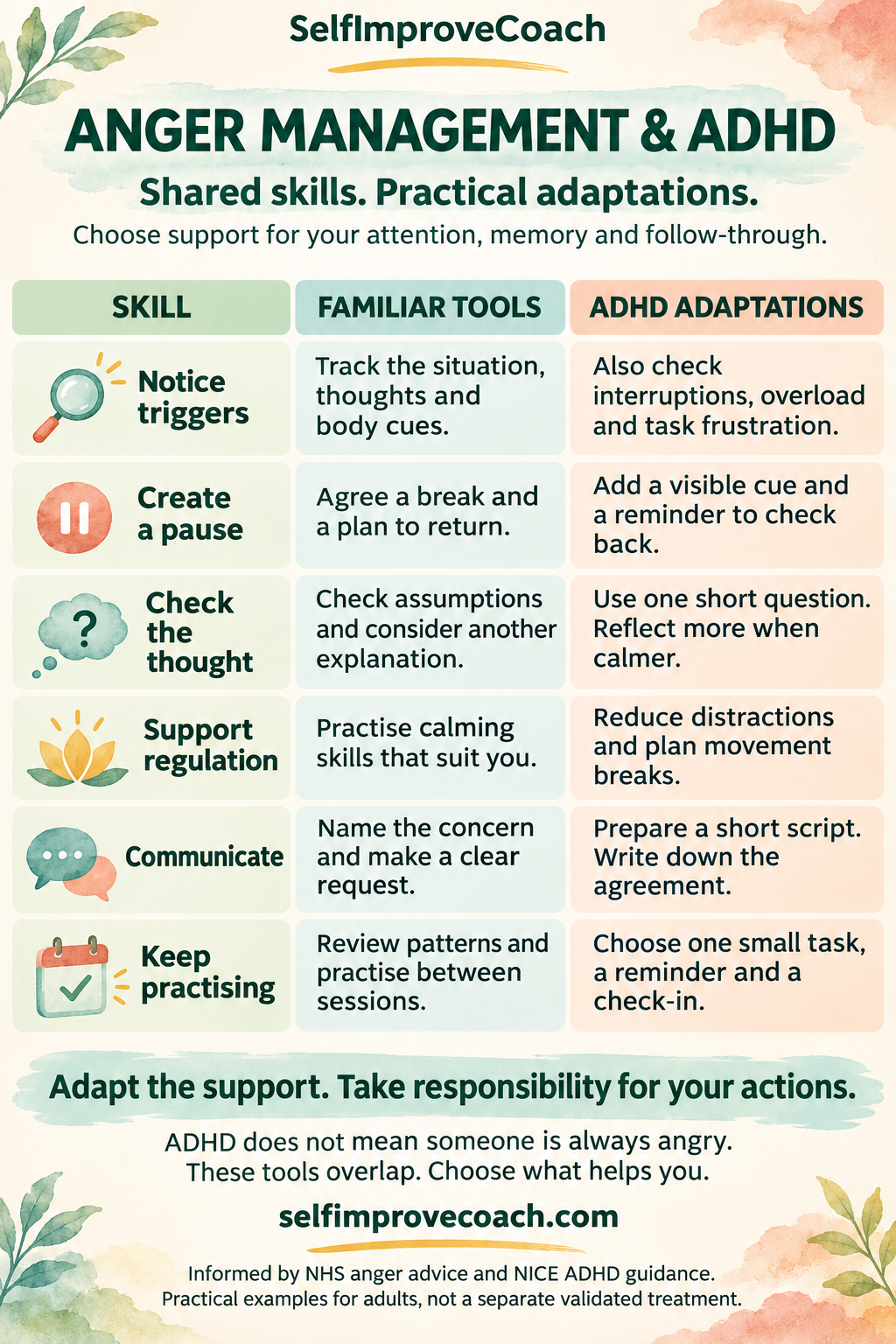
The infographic accompanying this article compares familiar anger-management tools with ADHD adaptations across six areas: noticing triggers, creating a pause, rethinking the moment, supporting regulation, communicating and keeping up practice.
These approaches overlap. The aim is to make useful skills easier to access in everyday life.
Anger is a feeling. What happens next matters.
Anger can signal that something feels unfair, hurtful, threatening or too much. Learning to manage it does not mean agreeing with everything, hiding your needs or never feeling angry. CBT approaches help people understand patterns and express anger more constructively. [1]
You can take your feelings seriously while taking responsibility for your behaviour. Shouting, threatening, breaking things or frightening someone still needs attention, whatever contributed to it.
Where ADHD can make things harder
ADHD can affect attention, impulse control, organisation and the ability to follow through on tasks. [2] Some people with ADHD also experience emotions that feel intense or difficult to manage. This can include frustration and anger, but it does not describe everyone with ADHD. [3]
For someone who struggles to hold several steps in mind, a long worksheet may be difficult to use during a disagreement. Someone else may intend to return after a break and lose track of time. The support needs to address the particular difficulty.
NICE recommends considering environmental changes as part of ADHD care. Where psychological treatment is indicated for adults, it recommends structured support focused on ADHD with regular follow-up; this may include CBT. [4]
The examples below apply those principles to anger-management practice. They are practical suggestions to try and review, rather than a claim that each adaptation has been separately tested as an ADHD anger treatment.
1. Notice triggers: include what was building up
A familiar starting point is to record what happened, what went through your mind, what you felt in your body and what you did next.
An ADHD adaptation: add a quick check of the demands around you. Were there repeated interruptions? Too many instructions? A task you could not get started on? Noise or other distractions that felt difficult to manage?
For example, “I snapped when I was asked a question” gives one part of the picture. “I was trying to finish a difficult form, the television was loud, and I thought I was being criticised” gives you more places to intervene.
Try a short record:
- What happened? I was interrupted while completing a form.
- What did I notice? Tight jaw, rushing thoughts, urge to shout.
- What added to it? Noise and losing my place.
- What might help next time? Save my place and ask for a quieter moment.
Treat these as possibilities to investigate. ADHD should not become the explanation for every difficult interaction.
2. Create a pause: make returning part of the plan
NHS anger advice suggests giving yourself time before reacting and recognising anger early. [5]
An ADHD adaptation: make the pause visible and give it a clear next step. Agree a phrase when you are both calm, keep a reminder where you will see it, and use a timer if that helps you remember to check back.
For example:
“I want to sort this out. I’m getting too wound up to speak clearly. I’ll take a break and check back with you at 7.30.”
Choose a time that fits the situation. The timer is a reminder to check whether you can talk constructively; it is not a demand to restart while either person still feels unsafe or overwhelmed. If you need longer, communicate a new plan where it is safe to do so.
A pause works best when it is agreed and does not become a way to punish someone or avoid the issue indefinitely.
3. Rethink the moment: start with one question
CBT can help you examine an interpretation such as “They’re doing this deliberately” and consider what else might explain the situation. [1]
An ADHD adaptation: use one brief prompt at first, then explore the details later. For example:
“What do I know, and what am I assuming?”
Imagine a colleague sends a short message asking for an update. Your first thought is, “They think I’m useless.” Another possibility is that they need the information for their own deadline. You can ask for clarification before responding to the assumption.
Checking your interpretation does not mean dismissing real mistreatment. You may still need to set a boundary or raise a concern. The question helps you choose a response that fits the evidence.
4. Support regulation: change the setting as well as the response
NHS advice includes calming breathing and physical activity among options for managing anger and stress. [5]
An ADHD adaptation: consider what would make the surroundings easier to manage. NHS ADHD advice includes quieter workspaces, written instructions and help structuring tasks as possible adjustments. [2]
For an anger-management plan, you might try turning off background television before a difficult conversation, discussing one issue at a time, or taking an agreed movement break. Choose what suits you; sitting still and focusing on your breathing will not be everyone’s preferred starting point.
Practise a manageable response at a calmer time, so you have some experience of using it before a difficult moment.
5. Communicate: prepare the words and record the agreement
Once you can speak more calmly, identify the concern and ask for something specific.
An ADHD adaptation: prepare a short script you can read, type or rehearse. Then write down any agreement so neither person has to rely entirely on memory.
For example:
“When plans change at the last minute, I find it difficult to reorganise. Could you text me as soon as you know, even if the new plan is not settled?”
Keep the request practical. “Please give me one instruction at a time” is easier to act on than “You need to understand me better.”
If you have spoken harshly, include repair:
“I raised my voice, and that was not okay. I’m sorry. I still want to discuss the change of plans, and I’ll do that without shouting.”
An explanation can help someone understand what happened. Repair also needs changed behaviour.
6. Make practice stick: shrink the task
NHS advice recommends small, achievable targets. [5] You do not have to complete a detailed diary after every disagreement to begin learning something useful.
An ADHD adaptation: agree one small practice task and a reminder that fits an existing routine. For example: “After dinner on Wednesday, I’ll spend two minutes noting one early warning sign.”
You could use a tick box, a few words on your phone, or a voice note where you can record privately. In therapy, begin the task together and agree when you will review it.
If it does not happen, explore the obstacle. Was it too long, easy to forget, unclear or uncomfortable to revisit? Change the task or the support before simply setting it again.
Choose support around your needs
Someone with ADHD may prefer a detailed thought record. Someone without ADHD may find a short visual reminder much easier. These formats are options, not categories people have to fit into.
Start with one recent example and ask: “Where would a little more support have helped me choose my next action?”
Try a free anger-management worksheet
Start with triggers, a pause-and-return plan or a clear conversation script. Each topic has a standard CBT version and an ADHD-adapted option, with worked examples and space to practise.
Explore the six free printable and fillable worksheets. No email address or account is needed.
When to seek more support
Speak with your GP or a qualified therapist if anger is affecting your relationships, work or wellbeing, or self-help is not enough. [5] Anger on its own does not establish an ADHD diagnosis; assessment considers a wider history and pattern of difficulties. [2]
If there are threats, intimidation, violence or controlling behaviour, prioritise safety and specialist support. A shared communication worksheet should not be used to make someone responsible for preventing another person’s harmful behaviour. If anyone is in immediate danger, call 999.
General educational information for adults. These ideas do not replace individual assessment or treatment.
Sources and further reading
Sources checked 6 November 2026. The practical scripts and worksheet concepts are original educational examples informed by the guidance below. They are not official NHS or NICE worksheets, and no endorsement is implied.
- NHS inform: Anger problems self-help guide
- NHS: ADHD in adults
- East London NHS Foundation Trust: Adult ADHD Support Resource Pack — managing overwhelming emotions
- NICE NG87: ADHD diagnosis and management — recommendations, particularly environmental modifications and recommendations 1.5.15–1.5.18.
- NHS: Get help with anger
Put an idea into practice
Explore worksheets and reflection tools for personal use and professional practice.
Browse free downloads →