
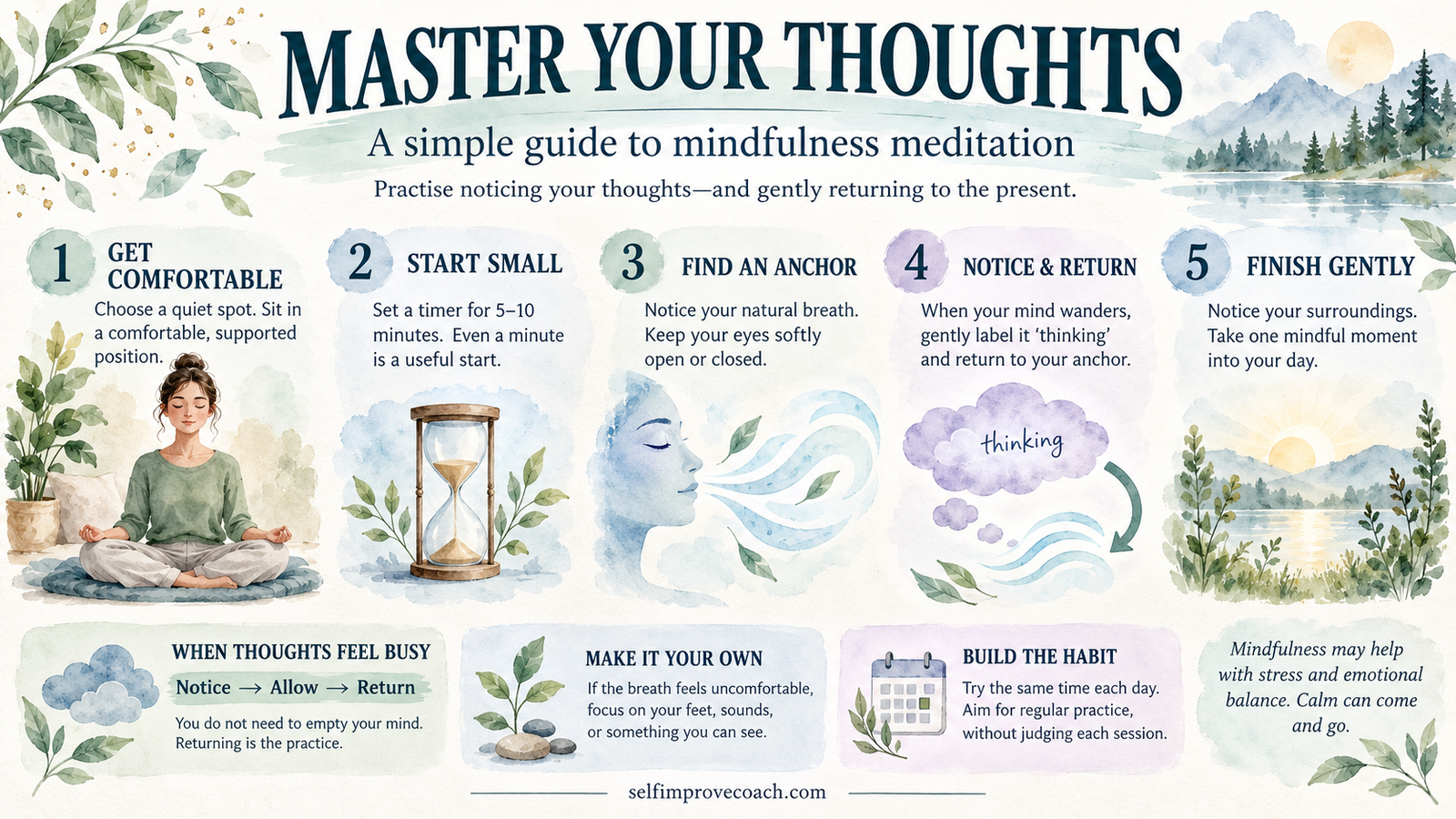
Mindfulness involves noticing present experience, including thoughts, feelings, sensations and surroundings. It is not a test of concentration, a way to empty the mind or a promise of inner peace.
You may find it useful at some times and unhelpful at others. Mindfulness is not right for everyone.
Try a brief, flexible practice
- Choose an anchor. This might be an everyday sound, an object you can see, contact with the chair or comfortable breathing. You do not have to focus inside your body.
- Notice a little detail. Give your chosen experience a few moments of attention. Keep your eyes open if that feels more comfortable.
- Recognise wandering. When you realise your attention has moved, you might quietly label it “thinking” and return to your anchor. Wandering is part of the experience, not a failure.
- Choose whether to continue. A short pause is enough for an experiment. You can move, look around, change the anchor or stop.
Look for usefulness, not a particular feeling
Afterwards, ask what you noticed and whether the practice helped you respond to the moment. Feeling calm is not a required result. You do not need to argue with a thought or make it disappear.
When another approach may fit better
Some people find mindfulness makes them feel worse. If it increases distress, stop and choose a more suitable activity or support. Persistent difficulty deserves individual advice rather than pressure to practise harder.
This introductory exercise does not replace assessment or treatment.
For therapists, agree the purpose and check suitability collaboratively. A guided, adapted practice and a clear way to stop can be more appropriate than a generic instruction to close the eyes and focus on breathing.
Further reading
General education and reflection; not individual assessment or treatment advice. Updated 24 October 2026. The examples are fictional.
Put an idea into practice
Explore worksheets and reflection tools for personal use and professional practice.
Browse free downloads →