

You send a message and get on with your day. Then you notice there is still no reply. You check again. Perhaps they have read it. Perhaps they have been online. Suddenly, a small space on a screen starts to feel like an answer: “I have upset them.” “I am too much.” “They do not really want me around.”
You might feel anxious, angry or ashamed. You want to ask what is wrong, but worry that asking will push them further away. So you apologise for something you are not sure you did, send another message, or decide you will never contact them again. The evening disappears into waiting, and your confidence goes with it.
It can be painful to feel unseen or unimportant. Understanding your response does not require pretending that every silence is harmless. It means looking closely enough to choose what fits this situation, rather than letting the most painful explanation make every decision.
The gap between no reply and what it means
“There has not been a reply” is an observation. “I have been rejected” is a possible meaning. Those can feel identical when the relationship matters, especially if you have experienced being dismissed or left guessing before.
The meaning may be about the other person: “They are angry.” It may become a judgement about you: “Nobody could put up with me.” Or a rule appears: “If I mattered, they would answer immediately.” A delay now carries a much bigger question about your worth or the security of the relationship.
There may be relevant history. Someone may repeatedly ignore agreed arrangements, respond only when they need something, or use silence to frighten or punish you. Those actions deserve attention. There may also be ordinary limits: work, sleep, illness, caring responsibilities, overload or a different way of using messages. You do not yet know which explanation fits simply because the phone is quiet.
A familiar moment: Maya's story
Maya and Jo are fictional friends. Maya messages on Wednesday to ask about coffee on Saturday. By Thursday evening, Jo has not replied. There is no urgent decision, and they have not agreed a response time.
Maya thinks, “I must have been boring last time. She is avoiding me.” She rereads their last conversation and sends, “Sorry if I said something wrong.” For a moment, she feels she has done something to protect the friendship. Then she starts waiting for that reply too.
Now the silence seems even more significant. She checks her phone while making dinner and loses track of what she was doing. Eventually, she feels angry: “Why do I always have to try?” She considers cancelling the invitation before Jo can reject it.
The first message asked about coffee. The later actions are trying to answer a different question: “Am I still wanted?” That is an understandable question, but another message may not settle it for long, especially when the answer you need is certainty about someone else's feelings.
How the waiting can become a loop
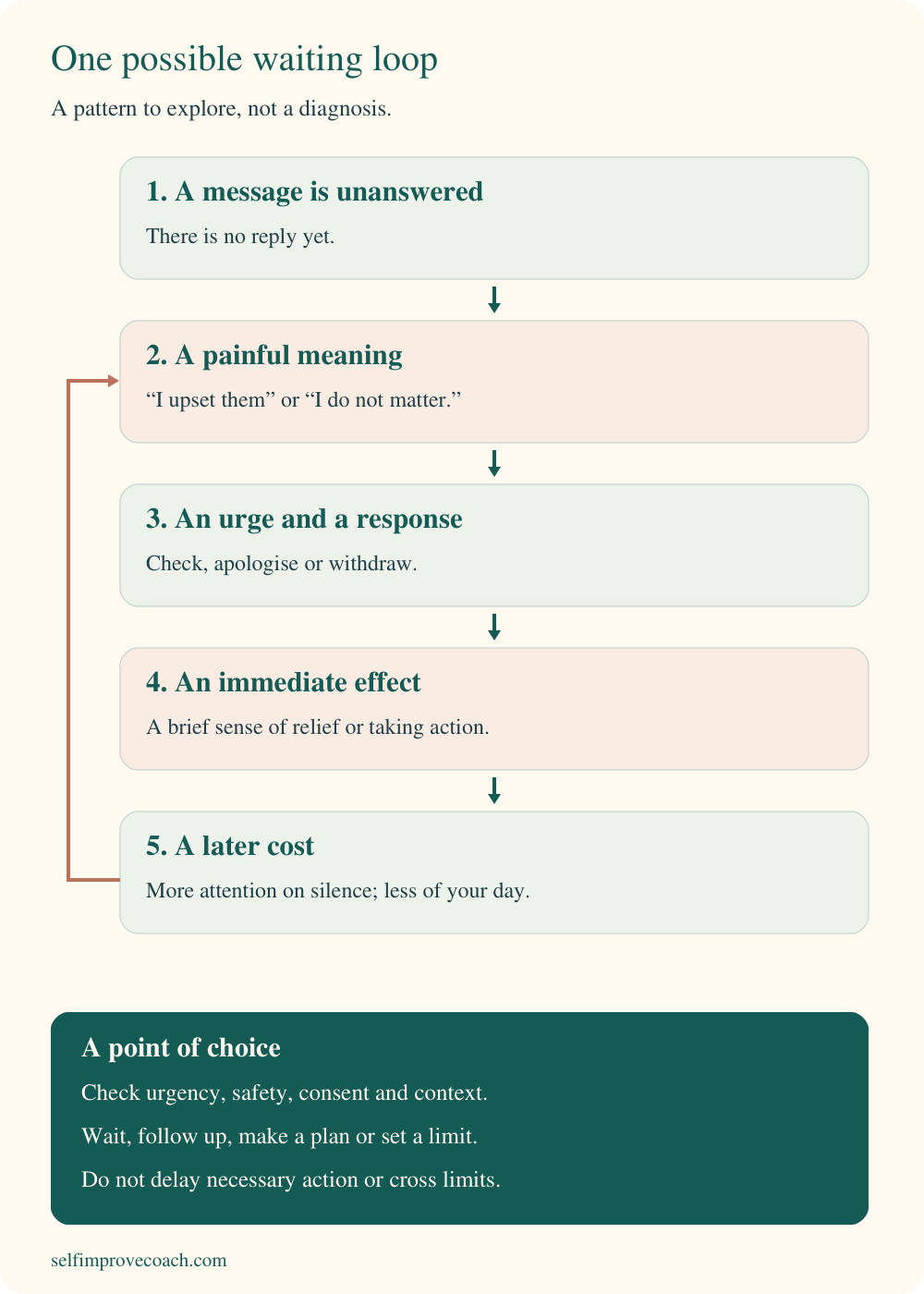
One possible sequence is: no reply, a painful meaning, a strong urge, an action to get certainty, then more attention on the silence. Checking may briefly feel purposeful. An apology may feel like taking control. Withdrawing may feel like getting ahead of rejection. Later, you may have less clarity, more messages to interpret and less of your own day left.
This is a pattern to explore, not a diagnosis or a fixed personality type. Ordinary connection, practical follow-up and asking for support are not automatically problems. What matters is the function and effect of the response in this situation.
The Centre for Clinical Interventions describes how reassurance seeking can ease uncertainty briefly while keeping anxiety going over time. That general principle may fit part of a waiting loop. It does not mean every request for reassurance is unhelpful, or that the right response is to stop seeking comfort from people altogether.
Check the situation before changing your response
Start with a practical question: is this ordinary waiting, or is action needed? A time-critical work decision, an agreed collection, a caring responsibility or a credible concern about someone's safety may need a proportionate follow-up or an appropriate established procedure. Do not use a waiting exercise to postpone necessary action.
Also check consent. If someone has asked for space or no contact, another message is not a suitable way to test whether they care. Respect their boundary. If you are frightened of the consequences of not replying yourself, or someone monitors, threatens or controls you, this is not simply a problem of interpreting messages. Prioritise safety and appropriate support.
For ordinary, non-urgent waiting, ask what you actually know. Has a reply time been agreed? What is usual for this person? Is there a repeated pattern with practical consequences? Keep the answers brief. You do not need to investigate their activity, recruit friends to check on them or build a case about their intentions.
A more balanced sentence can leave something unknown
You do not have to replace “They are rejecting me” with “They definitely care and are just busy.” That second statement may be comforting, but you may not know it either.
Try something more accurate: “I have not had a reply, and I feel hurt. I do not yet know why. I can decide what to do about Saturday without deciding what I am worth.”
NHS guidance on reframing thoughts recommends examining evidence and considering other explanations. It also recognises that changing a thought is not always possible. The purpose here is flexibility, not forcing yourself to feel positive or finding a sentence that removes every doubt.
If the evidence shows repeated unreliability, a balanced response can say that plainly: “This has happened several times, and I need a plan I can rely on.” Understanding a thought does not mean arguing yourself out of a reasonable need.
Choose a response that serves a purpose
Maya decides to make dinner and leave the question open for now. She is not ignoring an urgent matter, and there is no need to send an apology without knowing that anything went wrong. If she still needs to make Saturday plans on Friday, she can send one practical message: “Are you up for coffee tomorrow? If I have not heard by this evening, I will make another plan.”
That is an example, not a universal number of messages or waiting period. The timing depends on context, agreements, access needs and what needs deciding. A reasonable follow-up asks for information or states a practical limit. It does not require the other person to prove their feelings or make themselves constantly available.
Your next step might be waiting, making another plan, asking one clear question, setting a boundary or seeking support. You can keep necessary notifications available if you have work or caring duties. You do not have to put your phone away completely to show that you are doing the exercise correctly.
Let your day contain something besides waiting
Choose one activity you would still value even if a reply did not arrive: eat, shower, finish a small task, draw, go outside or speak to someone about a different part of your day. The activity is not a trick to make the other person respond, and you do not have to stop feeling hurt first.
If you check again, notice what happened without restarting a punishment or a perfect streak. Were you expecting a practical update? Looking for certainty? Following a habit? Return to the decision that fits the situation. If monitoring your checking becomes another consuming task, use less recording and discuss a different approach with a therapist.
A reply is information, not a verdict on your worth
In the fictional example, Jo later says she was on shifts and cannot do Saturday, but offers Sunday. Maya can record that actual response. It does not prove every future silence will have the same explanation. It does show that her first conclusion was not the only explanation on this occasion.
If there is no reply, you do not need to keep your plans suspended indefinitely. You can act on the practical information available: the arrangement is unconfirmed. You may feel disappointed and still choose another plan. If a relationship repeatedly leaves you waiting, a separate conversation about communication or a decision about what you can rely on may be appropriate.
If someone says they do not want further contact, that can hurt. Respect the answer and seek support for yourself rather than treating another message as the next exercise. A person's choice about a relationship is not a measurement of your value as a human being.
Try one small practice
Choose one manageable, non-urgent situation. Write what happened, the meaning that appeared, and what you feel urged to do. Check whether practical action, safety or consent changes the task. Then choose one response and one ordinary activity while some uncertainty remains.
Review briefly: what did you do? What actually happened? Did the task help you make a choice, or lead to more checking? What does the practical situation or wider pattern need now? You can finish without knowing exactly what the other person thinks.
When more support would help
If waiting and fears of rejection regularly take over your day, damage relationships, lead to unwanted repeated contact or affect sleep and functioning, consider appropriate professional support. Similar experiences can occur in different difficulties; this article cannot identify a diagnosis or explain your history from a message pattern.
Where silence occurs alongside threats, coercion or fear, seek suitable support rather than treating it as a thought you need to challenge. Where there is a credible immediate safety concern, use appropriate urgent help. The aim is a response that fits your circumstances, not more tolerance of harm.
Sources and scope
Original SelfImproveCoach explanation and fictional example, informed by NHS guidance on reframing unhelpful thoughts, NHS guidance on healthy relationships, CCI guidance introducing reassurance-seeking resources and NHS guidance on domestic abuse. Sources checked 31 October 2026. Educational support, not individual assessment, a validated intervention or a complete treatment programme.
Related reading: Space without disappearing · When disagreements escalate · Browse the free library
Put an idea into practice
Explore worksheets and reflection tools for personal use and professional practice.
Browse free downloads →