

You meant to ask about the dishes. Ten minutes later, you are defending everything you do for the household. Someone says, “You always make this a problem.” Someone else stops speaking. The dishes are still there, and now you feel angry, ashamed or painfully alone.
Afterwards, you might replay your tone, collect evidence that they never listen, or tell yourself you should have kept quiet. Perhaps the argument spoils the evening, keeps you awake or makes the next conversation feel risky. You want to be understood, yet the way you try to make that happen seems to push understanding further away.
A disagreement can be about a real problem and carry a personal meaning at the same time. Exploring both gives you more to work with. It does not mean blaming yourself for someone else's behaviour or learning to tolerate mistreatment.
When the issue starts to mean something more
A forgotten task might mean, “I am carrying this on my own.” A request to change plans might land as, “What I want never matters.” Being corrected can feel like being judged, especially when you already doubt your confidence or competence.
Sometimes that meaning fits a long-standing imbalance. Sometimes you have filled in an intention you cannot yet know. Often there is a mixture: a genuinely frustrating event, a familiar fear and very little energy left to sort them out.
Imagine Nadia and Ben, a fictional couple. They agreed Ben would book a repair before Friday. On Thursday, Nadia discovers he has not called. She thinks, “If I do not keep checking, nothing happens. I am on my own again.” Ben hears her sharp question and thinks, “Whatever I do, I am a disappointment.”
Nadia presses harder because she wants the responsibility taken seriously. Ben lists everything else he has done because he wants the criticism to stop. She experiences that as dismissal. He experiences her next question as another accusation. A practical problem has become a struggle to be seen as someone who matters.
Understanding that pattern does not excuse Ben's missed agreement or Nadia's insults if she uses them. Each person remains responsible for their actions. Nor can we assume every argument involves equal power, equal harm or equal freedom to leave the conversation.
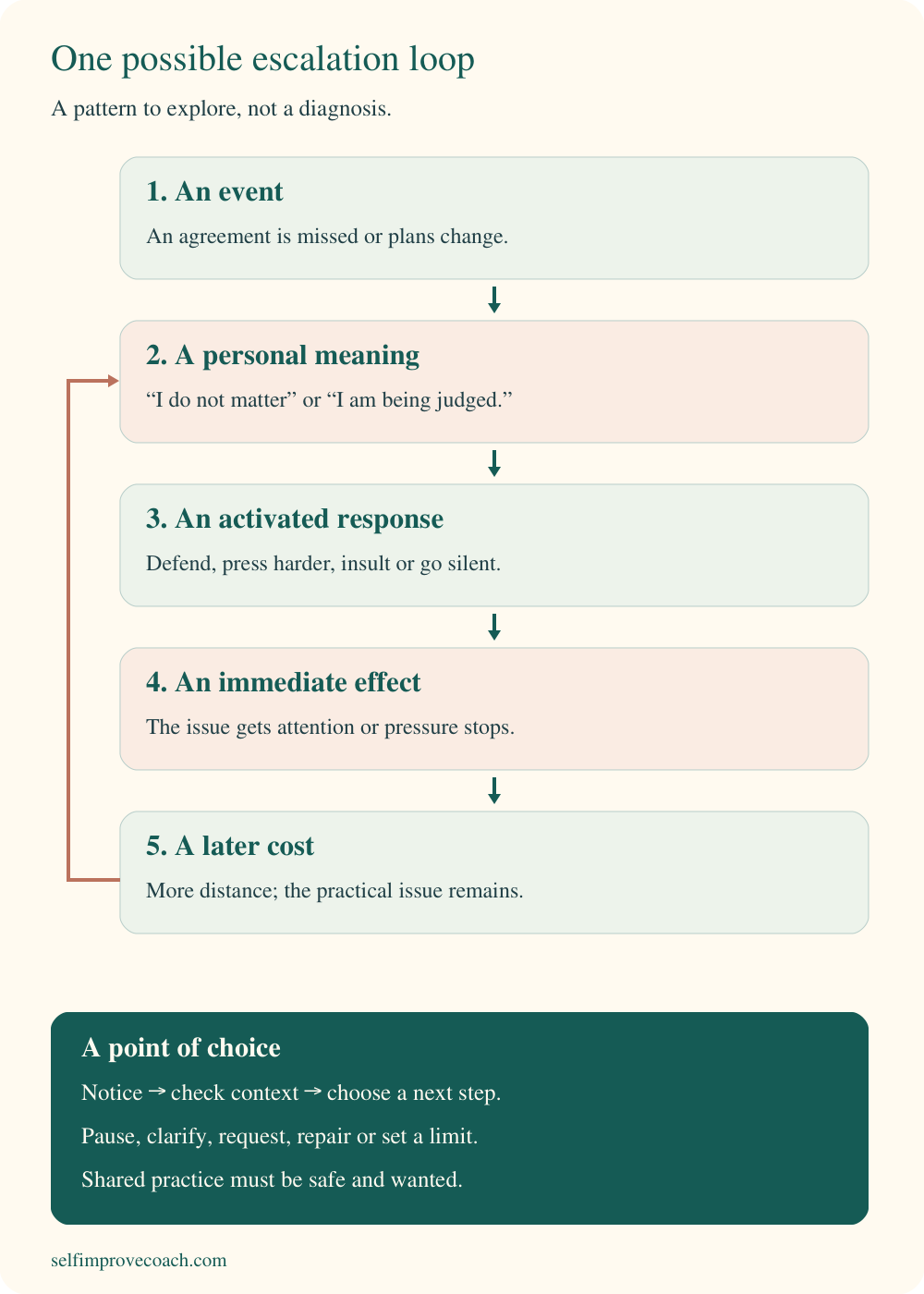
One possible escalation loop
An event happens. You give it a meaning. Your body becomes more activated, and you feel an urge to defend, prove, pursue or disappear. Your response affects what happens next. The other person's response can then seem to confirm the meaning you started with.
For Nadia, raising her voice briefly makes the issue harder to ignore. Later, it leaves both people defending themselves and the repair still unbooked. For Ben, listing his contributions briefly protects him from feeling inadequate. Later, Nadia feels less heard and presses harder.
This is one possible explanation to explore. It is not a diagnosis, a fixed relationship type or proof that the original concern was unreasonable. You might recognise only part of it, and different situations may need different responses.
Notice the earliest usable sign
You do not have to catch the first flicker of irritation. Look for a sign you can realistically recognise: speaking faster, interrupting, feeling hot, rehearsing your next defence, using “always” or “never”, or wanting to send a long message immediately.
The NHS describes physical and behavioural signs of anger and recommends recognising it early and allowing thinking time before reacting. The useful question here is small: “Am I still able to discuss this issue, or am I trying to win, escape or make them feel what I feel?”
Anger itself is not a failure. It can point to unfairness, hurt or an ignored limit. What you do with it matters. Feeling angry does not make threats, intimidation, blocking someone's exit or damaging their belongings acceptable.
A pause needs a purpose
If it is safe to speak, a pause can be clear rather than mysterious: “I want to sort out the booking. I am speaking sharply, and I need to stop for now. Could we come back to this after dinner at seven?”
Choose a realistic time or check-in, rather than promising to be calm in a fixed number of minutes. The other person can ask for a different time. A pause is not permission to follow them around, demand reassurance or insist they resume when you decide. Equally, repeated postponement without a practical next step may leave the original issue unresolved.
During the break, do something that helps you regain enough space to choose: have water, move to a quieter place, attend to a sensory need or jot down the one issue you want to discuss. Building a prosecution case in your head may leave you ready for the next round rather than the next conversation.
If you cannot speak safely, you do not owe a perfect pause phrase or a promise to return. Prioritise safety and suitable support. This exercise is for ordinary disagreements where communication practice is appropriate.
Return to one issue, one meaning and one request
Nadia's second attempt might be: “We agreed the repair would be booked before Friday, and it has not been done. I felt left carrying it. I should not have called you useless. Can we decide who will phone and when?”
That statement does several jobs. It names the event without guessing Ben's character. It makes Nadia's experience understandable. It takes responsibility for an insult without cancelling the original concern. It asks for a practical decision.
Ben might say, “I forgot. I can phone at nine tomorrow.” He might explain an obstacle or disagree about what was agreed. Nadia can listen and check: “Are you saying you understood we would decide on Friday?” Checking what someone means is different from agreeing with it.
They may discover a misunderstanding, an unfair division of work or an agreement that is repeatedly not kept. Those need different next steps. Better wording cannot do the other person's part, and a respectful request does not guarantee cooperation.
Repair is more than ending the tension
It can feel tempting to apologise for everything so the atmosphere improves. But “Fine, it was all my fault” may buy peace while leaving resentment underneath. It can also hide the actual work of repair.
A more specific repair names the action and its impact: “I interrupted you and called you useless. That was hurtful. Next time I will stop before I carry on like that.” Follow through with a practical change. The other person may need time, and you cannot require forgiveness as a reward for apologising.
You can also hold a boundary: “I want to discuss this, and I will not stay in a conversation with insults.” Someone else's distress does not remove your right to stop. Your own distress does not remove their right to do the same.
When anxiety, low mood or exhaustion are part of it
Worry about rejection may make disagreement feel like the start of someone leaving. Low confidence may make a correction feel like proof that you are failing. Exhaustion, pain, sensory overload and repeated demands can leave less room for an already difficult conversation.
These are possibilities to explore, not explanations to assume. Arguments alone do not identify an anxiety or depression disorder. If conflict sits alongside persistent distress or difficulties functioning, a therapist can help understand the wider picture. A communication sheet is one support; it is not a substitute for assessment or a condition-specific treatment.
For therapists, the client's goal might be fewer insults, a clearer boundary, shared responsibility or less time spent replaying arguments. Agreement, reconciliation and staying in a relationship are not universal measures of progress.
Find one useful next step
Choose an ordinary disagreement that feels manageable to revisit. Write four short notes: what happened; what it seemed to mean; what you did; and what followed. Then ask what would have helped most: a pause, clarification, a practical agreement, a limit or outside support.
You do not need to analyse every conversation. Try one change and review it briefly. Did you express the concern more clearly? Did the practical issue move forward? Did either person feel pressured or unsafe? What remains unresolved?
The aim is not to become perfectly calm or endlessly understanding. It is to have more choice when something matters—and to recognise when the next step needs more than a different sentence.
When a communication exercise is not enough
Fear, coercive control, threats, stalking or violence need an appropriate safety response. The person choosing harmful behaviour is responsible for it. Do not use this article to persuade yourself that abuse would stop if you communicated better, or to pressure someone into joint practice or unwanted contact.
The NHS has guidance on recognising domestic abuse and finding support. Seek appropriate professional help if anger feels difficult to manage, your actions harm others, or recurring conflict is affecting your wellbeing. In immediate danger, contact emergency services.
Sources and scope
Original SelfImproveCoach educational explanation and fictional example, informed by NHS guidance on anger, NHS guidance on healthy relationships and NHS guidance on domestic abuse. Further communication guidance: HealthyWA assertive communication. Sources checked 31 October 2026. This article is not individual assessment, a validated intervention or a complete treatment programme.
Related reading: Saying yes, then feeling resentful · Space without disappearing · Browse the free library
Put an idea into practice
Explore worksheets and reflection tools for personal use and professional practice.
Browse free downloads →