

You make a mistake. Someone sounds annoyed. You say yes when you meant no. Before you have worked out what happened, you are angry with yourself.
“Why am I like this?” “I should have known better.” “I ruin everything.”
You might replay the moment, work late to make up for it or pull away from people. Perhaps you feel too guilty to rest. A small problem starts to feel like proof that you are a bad person.
This can wear down your confidence. It can also make the original problem harder to solve. You are busy judging yourself when you need a clear next step.
What does turning anger against yourself look like?
It can mean calling yourself names, blaming yourself for the whole problem or setting a harsh rule. “I cannot stop until this is perfect.” “I do not deserve a break.” “I should never need help.”
Sometimes it follows something you did. At other times, you are upset about how someone treated you. Yet the anger quickly becomes, “I am stupid for letting that happen.”
These are different situations. You may need to correct a mistake, set a limit or get support. Attacking yourself does not tell you which one fits.
The NHS notes that anger can affect people in different ways. Some show it towards others. Some hide it or direct it at themselves. This article focuses on harsh self-talk and self-blame. It is not a guide for managing self-harm or a crisis.
Why might you be so hard on yourself?
You may believe that criticism keeps you careful. “If I stop being hard on myself, I will make the same mistake again.” It may feel like a way to stay in control.
You might also fear other people's anger or rejection. Blaming yourself first can seem safer than saying that something was unfair. Or you may have heard harsh words so often that they now sound like your own voice.
These are possible reasons to explore. They are not facts about everyone. You do not need to find one hidden cause before you can respond differently today.
Self-criticism may push you to act for a while. But ask what happens later. Do you learn and move on? Or do you feel ashamed, avoid the task and find it harder to try again?
Dan's story: a mistake becomes a judgement
Dan is a fictional example. He promised to email a draft newsletter to his club organiser by noon. He forgot. At two, the organiser asks where it is.
Dan thinks, “I am useless. People cannot rely on me.” He feels angry and ashamed. He decides he must keep working without lunch until the whole newsletter is perfect.
For a moment, that feels like taking responsibility. Then he keeps checking small details. He still has not sent the organiser an update. He misses his planned walk and feels worse.
The missed email needs a response. The claim that Dan is useless does not help him choose one. His harsh rule also creates a new problem: he is tired and hungry while trying to fix the first one.
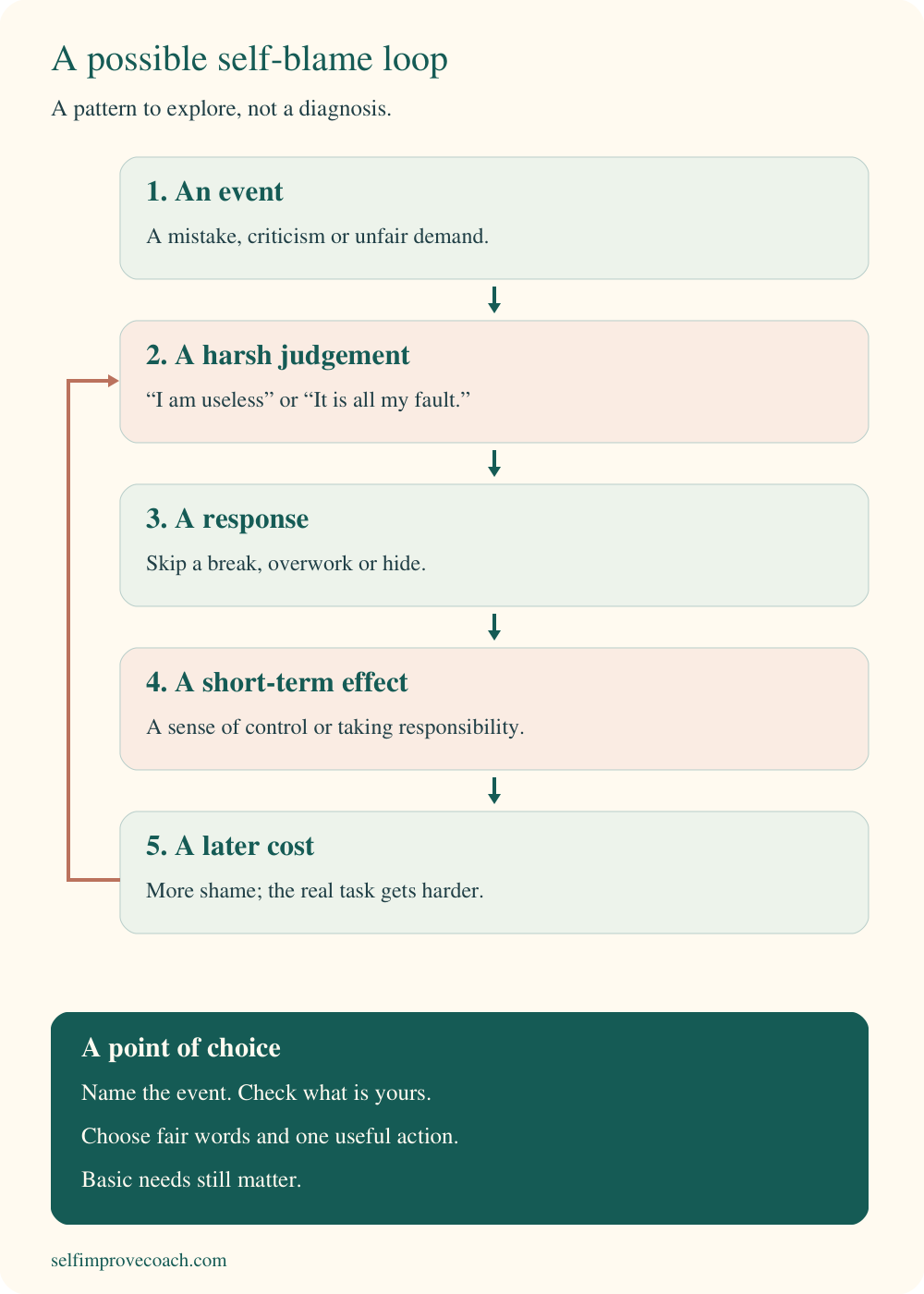
A possible self-blame loop
An event happens. You judge yourself as a person. Anger or shame grows. You punish yourself, overwork or avoid. The task gets harder, and that seems to confirm the judgement.
This is one pattern you might recognise. It is not a diagnosis. People can struggle with self-criticism for many reasons. Depression is not simply anger turned inward, and being angry with yourself does not prove you have depression.
The Centre for Clinical Interventions offers guidance on self-compassion. In plain terms, this means noticing that you are struggling and responding with care. Care can include facing a problem and doing something about it. It does not require pretending that no mistake happened.
Start with the event, not your whole character
Try changing “I ruin everything” into a plain account of the event.
For Dan: “I missed the time I agreed to send the draft.”
That statement is specific. It leaves him with something he can act on. It also avoids making one missed task stand for his whole life.
Then ask what else matters. Was the task clear? Did you have the time, tools and support needed? Were you unwell, overloaded or given new demands? These facts can affect the next step. They do not automatically remove your responsibility.
Sort out what is yours to do
Dan can tell the organiser that he missed the deadline. He can give a realistic new time and send the draft. Later, he can set a reminder.
He cannot undo the delay or control whether the organiser feels annoyed. He does not need to punish himself until they forgive him.
Your situation may be different. If someone has blamed you for their insults, threats or abuse, their actions remain their responsibility. Being treated badly is not proof that you caused it. A useful next step may be a boundary or support, rather than an apology.
Use fair words you can believe
You do not have to tell yourself that everything is fine. Try a fair statement that fits the facts and points to an action.
Dan chooses: “I missed the deadline. I can own that and send an update. I do not need to call myself useless to fix it.”
If kind words feel false, start with neutral words. “This is difficult. What needs doing now?” may be enough. You can say it once and move on. You do not need to repeat it until you feel calm.
You might find it easier to ask what you would say to a friend in the same situation. Use the same facts and standards. A fair response can name a mistake without attacking the person who made it.
Try one small practice
Ask what would reduce the problem rather than increase your punishment. The action may be to correct something, apologise for a clear harm, ask a question, set a limit or get help.
For Dan, it is a short message: “I missed the noon deadline. I can send the draft by three. Does that still work?” Then he sends what is needed and has lunch.
Rest, food and support are basic needs. You do not have to earn them by getting everything right. Attending to a need can sit alongside taking responsibility.
If another person was hurt, a repair may take more than words. Name what you did and change what you can. They may still be upset. They do not owe you quick forgiveness or a reply that makes your guilt go away.
Review once, then decide what next
After the action, ask a few short questions. What did I do? Did it help with the actual problem? Did I take more blame than was mine? What needs doing next?
Dan finds that the organiser can still use the draft. He has made a practical repair. He also learns that skipping lunch and checking every detail delayed the update.
That does not mean every mistake will have an easy outcome. Sometimes there are real costs. A fair response helps you face those costs and choose the next action. It does not promise to remove them.
If the review turns into another hour of self-attack, stop the sheet for now. You may need a shorter task or support from a therapist.
When it is hard to be on your own side
You may worry that care will make you lazy or careless. Treat that as a question, not a rule. In one small, safe situation, notice what happens when you use fair words and a clear action instead of insults.
You may still feel angry or guilty. The useful change is having more choice in what you do. Feeling better straight away is not the only sign that a response helped.
If harsh self-talk keeps affecting your sleep, work or relationships, consider talking to a GP or therapist. The wider pattern may need more help than one sheet can offer.
When you need urgent help
If you might hurt yourself, have already harmed yourself or cannot keep yourself safe, seek urgent professional help. Use NHS guidance on getting urgent mental health help. Contact emergency services or go to A&E if there is immediate danger. A reflection exercise is not enough in that situation.
Sources and scope
Original SelfImproveCoach explanation and fictional example. General guidance checked on 31 October 2026: NHS: Anger, NHS: Raising low self-esteem and CCI: Self-compassion. This is educational support, not a diagnosis, tested treatment package or replacement for personal care.
Related reading: Space without disappearing · When disagreements escalate · Browse the free library
Put an idea into practice
Explore worksheets and reflection tools for personal use and professional practice.
Browse free downloads →