

You want someone to notice you are struggling. Then they ask what is wrong, and you say, 'Nothing.' You leave their message unanswered, cancel the plan or find yourself picking an argument about something small. When they stop asking, it hurts. You feel forgotten, unimportant or hard to love, even though part of you wanted to be left alone.
Perhaps you feel ashamed afterwards. 'Why do I do this? Why can't I just say what I need?' It can be difficult to explain a reaction when you only understand it once the conversation is over. You may recognise the loneliness clearly while the moment that created the distance remains a blur.
Pulling away is a description of something you do, not a verdict about who you are. It can have different meanings on different days. You might need rest, fear criticism, feel let down or be protecting yourself from someone who treats you badly. Before trying to become more available, it helps to ask what the distance is doing for you, and what it costs.
What does pulling away look like for you?
It may be obvious: leaving a room, blocking a conversation or repeatedly declining invitations. It can also be quieter. You answer politely but share nothing, insist you need nobody, become busy whenever someone gets close, or make a joke when you are hurt. Sometimes you wait for the other person to prove they care, without telling them what would help.
These actions do not automatically mean the same thing. Taking longer to reply may reflect fatigue, caring responsibilities, concentration or a communication preference. Needing quiet after a demanding day is not a relationship failure. A useful starting point is a specific event: what happened, what you noticed, what you did and what happened next. 'I went quiet after that comment' gives you more to explore than 'I ruin everything.'
One possible loop: relief now, distance later
Imagine this sequence. A person you care about seems distracted. You interpret it as 'I'm not important to them.' Hurt arrives, perhaps with shame or anger. You turn away before they can dismiss you. For a while, you no longer have to risk asking for something and hearing no.
Later, the distance feels worse. They may assume you want privacy, become frustrated or withdraw themselves. You see less warmth and think, 'I knew they didn't care.' In this possible loop, the response changes the situation as well as protecting you from it. Neither person necessarily understands the other's intention.
This is a working explanation to explore, not proof that a fear is mistaken or that you caused another person's behaviour. They may have been dismissive. There may be a genuine disagreement, repeated disrespect or an unequal burden. Understanding your response should make the whole picture clearer, including what needs to change around you.
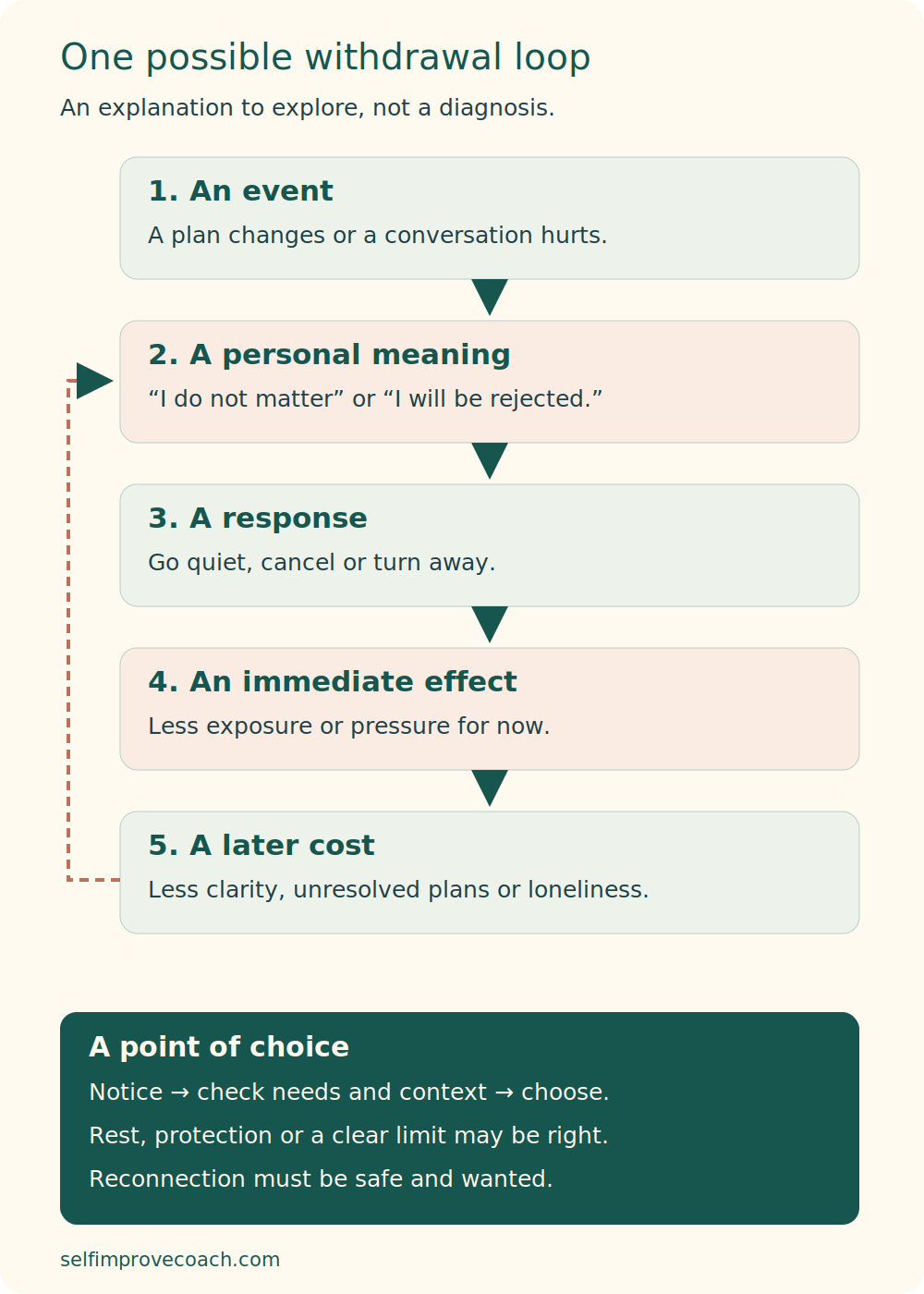
What might you be protecting?
Sometimes distance protects against an anticipated rejection: 'If I don't ask, I won't have to hear that I'm too much.' Sometimes it protects against shame: 'If they see how bad I feel, they'll think less of me.' Anger may express a need that has not found words: 'Why should I explain it? They should already know.'
You might also fear losing control of your feelings. You do not trust yourself to speak without crying, becoming angry or agreeing to something you do not want. Pulling away may be the quickest available way to stop the conversation. It can be understandable and still leave a problem unresolved.
Ask gently: 'What did I expect would happen if I stayed in this conversation?' If no answer comes, begin with your body or urge: tight chest, heat in your face, a blank mind, wanting the door closed. You do not need to uncover a childhood explanation to notice what would help today. Nor does this pattern establish an attachment style or a diagnosis.
Needing space is different from leaving everything unclear
A pause can be useful when talking has become difficult. The NHS suggests taking time out of conflict and returning when people feel calmer. The practical question is what the pause makes possible. Does it help you rest and think, or does the issue become harder to approach each time?
Where it is safe and feasible, a brief message can make the difference clearer: 'I am overwhelmed and need some quiet. I would like to come back to this tomorrow afternoon.' Choose a realistic check-in rather than promising a conversation you cannot manage. You can explain at that check-in if you need longer.
This is an offer of communication, not a rule that you must remain reachable. You do not owe ongoing contact to someone who harasses, threatens or repeatedly ignores your boundaries. If communication itself creates risk, prioritise support and safety rather than using a return message to keep the peace.
A fictional example: Sam and the cancelled plan
Sam has been feeling low and self-conscious. A friend, Leena, cancels dinner because work has run late. Sam reads the cancellation as confirmation that Leena would rather spend time with anyone else. Sam replies, 'Whatever,' then ignores a message suggesting another evening.
The silence initially feels protective. Sam does not have to admit being disappointed or risk a second cancellation. By the weekend, Sam feels isolated and angry that Leena has not tried harder. Leena thinks Sam does not want to rearrange. The original cancellation and the unspoken meaning have become tangled together.
After reflecting, Sam chooses a small response: 'I was disappointed and went quiet. I would still like to see you. Would a short walk on Sunday work?' Leena cannot do Sunday but offers Wednesday. Sam is still uneasy. The useful change is that the request is now understandable and Leena can answer it. This does not guarantee the friendship will feel secure; it provides information and an opportunity to decide what happens next.
If Leena repeatedly cancels without making space for Sam, that pattern deserves attention too. Clearer communication is not a demand that Sam accept an arrangement that remains painful or one-sided.
Try a smaller move than 'open up completely'
You do not need to explain every feeling or disclose something private to practise a different response. Choose one ordinary situation with someone who generally respects your limits. The following is an original SIC practice informed by broad communication and CBT principles, not a tested treatment programme.
1. Notice the moment before you disappear
Write one sentence about the event. Separate what was observable from what it meant to you. 'They looked at their phone while I was speaking' is different from 'They think I'm boring.' Both the event and the meaning matter; they are different kinds of information.
2. Check what you need and what is safe
Do you need quiet, rest, practical help, a clearer answer, a boundary or company without much conversation? Consider sensory overload, pain, disability, demands on your time and the other person's actual behaviour. If you are frightened of their response, a communication exercise may be the wrong next step.
3. Choose one understandable response
You might ask a question, name a specific hurt, request a pause or offer a manageable form of contact. For example: 'I'm tired and don't have much conversation in me. Would you like to sit with me for a while?' Or: 'When the plan changed, I felt disappointed. Can we choose another day?'
Use words that sound like you. A text, a note, a planned conversation or support from a therapist may be more accessible than speaking immediately. The aim is a clearer choice, not a performance of confidence.
4. Review the outcome briefly
What did you try? What did they actually say or do? Was the response respectful, disappointing, confusing or unsafe? What did you learn about your needs, this person or the situation? You may choose another small attempt, a different boundary or outside support. Feeling anxious afterwards does not by itself tell you whether the step was useful.
If you have already pushed someone away
Repair can begin with the action you recognise: 'I stopped replying after we disagreed. I can see that left things unclear.' Then say what you can offer now: 'I am not ready for a long conversation, but I can talk for ten minutes tomorrow.' You can acknowledge an impact without apologising for needing rest or accepting responsibility for the whole conflict.
The other person may need time, decline contact or describe how they were affected. A repair is an invitation, not a way to require forgiveness. If they have asked for no contact, respect that boundary. You can work on understanding the pattern without sending another message.
When the pattern needs more support
Persistent low mood, loss of interest, anxiety, trauma-related difficulties or an increasingly restricted life may need individual assessment. Withdrawal can occur in different difficulties; the right support depends on what is happening for you. CBT and other therapies offer ways to develop a shared understanding and choose purposeful work. This article does not identify which condition, if any, applies.
If you face intimidation, monitoring, threats or control, do not treat reconnecting as the goal. The NHS information on domestic abuse explains signs and support options. Someone else's abusive behaviour is not caused by your failure to communicate well enough.
A free practical starting point
Space Without Disappearing: A Pause-and-Return Sheet — three pages of instructions, a fictional example and your own practice. Printable and fillable in one PDF.
Find one useful next step
The free companion, Space Without Disappearing: A Pause-and-Return Sheet, offers instructions, a fictional example and space to prepare and review one small response. You can type into the PDF or print it and write by hand. There is no need to buy a pack to complete that practice.
If agreeing too quickly comes before the withdrawal, read Why Do I Say Yes, Then Feel Resentful?. For other starting points, explore the free resource library, including communication, emotional awareness and activity-planning resources. Choose a tool because it helps with your situation, not because you have to complete a sequence.
Sources and scope
These are original SelfImproveCoach explanations, examples and educational exercises. General communication guidance was checked against NHS healthy relationships information and CCI assertiveness resources. The clinical distinction between everyday withdrawal and condition-specific care was checked against NICE depression guidance and NICE social anxiety guidance. No source worksheets are reproduced. Educational support does not replace individual assessment or therapy.
Put an idea into practice
Explore worksheets and reflection tools for personal use and professional practice.
Browse free downloads →
2 Comments