

Someone asks for a favour. You are already tired, short of time or carrying more than they realise. You hear yourself say, 'Of course. No problem.' A few hours later, it feels like a very big problem.
You may feel angry that they asked, guilty for being angry, and disappointed that nobody noticed you needed a break. Perhaps you become short with them, avoid their messages or do the task while silently keeping score. Afterwards, you feel bad about the way you behaved. Next time, you promise yourself, you will say something. Then the next request arrives.
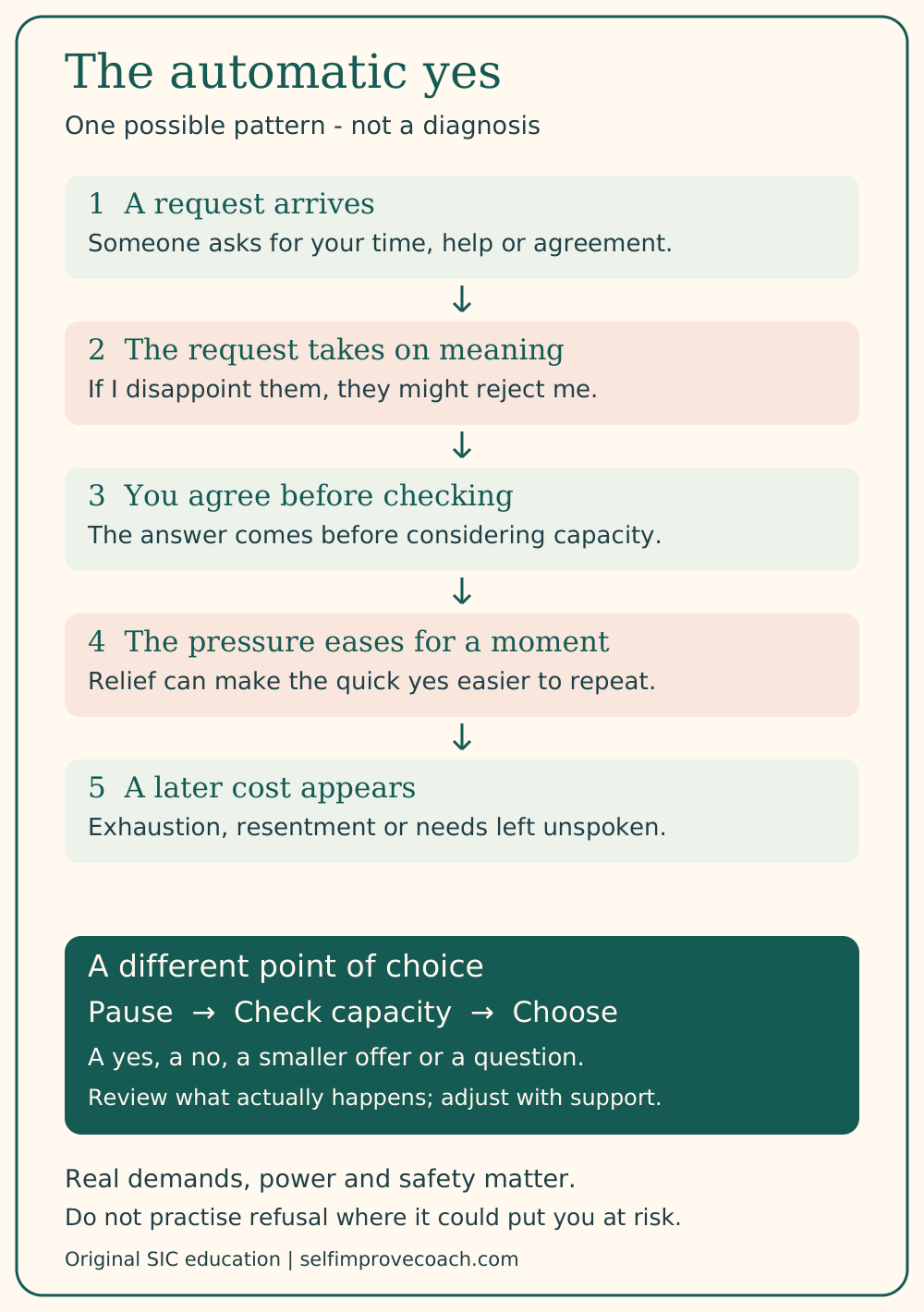
This pattern can be painful because there is often more at stake than the task itself. You may fear disappointing someone, being rejected, starting an argument or discovering that you matter less when you are less useful. Saying yes can feel like the safest way to keep a relationship steady, even when it leaves you feeling invisible within it.
A yes can be doing two different jobs
Sometimes yes expresses something you freely want to do: generosity, closeness, commitment or care. At other times it is mainly trying to get rid of a feeling. If the thought of saying no brings guilt, tension or a fear of anger, agreeing may offer immediate relief.
That relief can make the response easier to repeat. The later cost may be exhaustion, resentment or another abandoned plan of your own. This is one possible explanation for the pattern, not the explanation for every person. You might also be responding to unfair expectations, an unequal workload, financial dependence or a situation where refusal has real consequences.
The useful question is not 'Was I good or bad for agreeing?' It is 'What was happening for me when I answered?'
What might you be afraid would happen?
Try finishing one of these sentences, without assuming it must be true:
- 'If I say no, they might…'
- 'If they are disappointed, that would mean…'
- 'A good partner, friend, parent or colleague should…'
- 'I am only allowed to rest when…'
You may find a fear of people leaving, anger, criticism or being seen as selfish. Or a rule such as 'I must keep everyone happy' or 'My needs only count after everyone else's.' A rule can feel reasonable because you have followed it for years. That does not tell you whether it is workable now.
There can also be care and choice in a difficult yes. You may decide to help someone during a crisis even though it costs you time. The aim is not to eliminate sacrifice. It is to make the cost visible and allow your answer to reflect a considered choice rather than an automatic response to fear.
A fictional example: the weekend favour
Alex has planned a quiet Saturday after a difficult week. A friend asks Alex to help with a move. Alex imagines the friend thinking, 'You never make an effort,' and agrees to spend the whole day there. The friend's warm thanks brings a brief sense of relief.
By Friday evening, Alex is angry and withdrawn. The friend does not know about the cancelled plans or the exhaustion. Alex feels taken for granted; the friend thinks they have accepted a willing offer. Both are missing part of the picture.
The next time, Alex tries a smaller change: 'Let me check what I can manage and get back to you this evening.' After checking, Alex offers two hours in the morning. The friend would prefer more help and says so. Alex feels uncomfortable, but the conversation gives them more accurate information than silently agreeing and resenting it.
In this example the relationship is safe enough for that practice. Someone facing intimidation, punishment or coercive control may need a different plan and specialist support.
Before you answer: pause, check, choose
The Centre for Clinical Interventions describes assertiveness as communicating clearly while respecting others. Its self-help materials include examining beliefs and practising ways to decline requests. The following pause practice is an original SIC exercise informed by those broad principles; it has not been tested as a treatment programme.
1. Pause the automatic answer
Use a sentence that buys a realistic amount of time: 'Can I let you know this afternoon?' or 'I need to check my commitments first.' If a decision is genuinely urgent, take the briefest pause available and check the essentials. A pause is a way to consider the request, not a promise that you will say yes later.
Notice the pressure. Is it urgency in your body, guilt, a fear of conflict, or an expectation that you must explain yourself perfectly? You do not need to remove that feeling before continuing. Simply naming it can help you recognise that a feeling and a decision are different things.
2. Check capacity, choice and consequences
What exactly is being requested? How much time, energy or money would it involve? What would you need to postpone or give up? Do you want to do it, and does it fit your responsibilities and values? Are there practical obligations or safety concerns you need to consider?
Your capacity can change. An answer that was workable last month may be too much this week. If you want to help but cannot do the whole thing, consider whether a smaller offer is genuinely manageable. You do not have to find an alternative every time you decline.
3. Choose an honest, proportionate response
Possible answers include a considered yes, a clear no, a smaller offer or a request for more information. Keep the wording suited to the relationship and situation:
- 'Yes, I can help on Tuesday for an hour.'
- 'I cannot take that on this week.'
- 'I can do the first part, but I cannot manage the whole task.'
- 'Which task should take priority if this is added?'
A workplace instruction, caring obligation or contract may need negotiation rather than a simple refusal. The goal is to communicate the reality of your capacity, not pretend that every request is optional.
The guilt afterwards does not settle the question
You may feel guilty even after giving a fair, considered answer. You may want to send another message, offer more or undo the boundary so that everyone feels comfortable again. Before doing that, ask whether you have new information or are mainly trying to relieve the feeling.
Sometimes guilt points to something worth repairing: a promise you forgot, an unfair remark or a responsibility you overlooked. At other times it reflects a familiar rule that your needs should not inconvenience anyone. Look at what happened, what your responsibilities actually were and whether any repair is needed. Neither dismissing guilt nor obeying it automatically gives you the full picture.
If you decide that your answer was reasonable, give yourself time before revisiting it. Do something ordinary while the feeling settles: make a drink, return to the task you chose or speak to someone supportive. This is not a requirement to tolerate mistreatment. A threatening response calls for attention to safety and support.
If you have already said yes
You may be able to correct the agreement promptly: 'I answered too quickly. I can manage the morning, but not the whole day.' Acknowledge any inconvenience without turning the change into an apology for having limits. If someone has already relied on your commitment, discuss the practical impact and possible repair.
Sometimes changing the answer is not feasible. You can still learn from the moment. Write down what you expected would happen if you declined, what agreeing cost you and one sentence you could try next time. Understanding a pattern after the event is still useful; awareness does not have to arrive at the perfect moment to count.
When resentment is information
Resentment may alert you to an unspoken limit or an unequal arrangement. It does not prove that the other person intended to exploit you. Nor does it prove that the problem is entirely yours. You may need a conversation about workload, a clearer agreement, a repair after an argument or support with a relationship in which your needs are repeatedly dismissed.
Where it is safe, describe the specific issue: 'I have taken on the evening tasks all week and I am exhausted. Can we agree who does what?' Concrete information gives a conversation somewhere to go. 'You never care about me' may express real pain, but can leave both people defending themselves rather than addressing what needs to change.
A free practical starting point
Open Before You Say Yes: A Step-by-Step Pause Sheet. Includes instructions, an example and your own preparation and review pages.
Choose one small practice
Start with a low-stakes request from someone who usually treats you respectfully. Use the free 'Before You Say Yes' pause sheet to prepare one response and review what actually happened. You can also explore the existing Communication & Assertiveness resource pack or browse the free library for another starting point.
This is practice in making room for your own needs alongside other people's. You may still choose to help. You may still feel uncomfortable. The difference you are looking for is a little more honesty, choice and understanding in the moment before you answer.
Support and sources
These educational ideas are not individual assessment or treatment. If patterns are affecting your relationships, work or wellbeing, you may find it helpful to explore them with a therapist or other appropriate professional. If saying no could lead to intimidation, violence or punishment, prioritise safety and specialist advice; do not use this article as an instruction to confront someone. The NHS information on domestic abuse explains forms of abuse and routes to support.
Sources: CCI Assertiveness resources; NHS guidance on healthy relationships. The examples, pause sheet and collection are original SelfImproveCoach materials, not reproductions of the source worksheets. People-pleasing is used descriptively here, not as a diagnosis.
If replaying the conversation afterwards is familiar, explore Why You Replay Conversations Afterwards.
Put an idea into practice
Explore worksheets and reflection tools for personal use and professional practice.
Browse free downloads →
3 Comments