
An unanswered message can quickly become “I have upset them”. A pause in a meeting can become “Everyone thinks I am incompetent”. These interpretations can arrive so quickly that they feel like a description of what happened.
CBT offers a way to slow the moment down: notice the thought, consider what you know and explore a response that fits the situation. You do not have to make yourself feel positive or prove that every difficult thought is wrong.
Start with one specific moment
Choose a recent situation rather than trying to explain a whole difficult day. Separate the event from the meaning you gave it. “My colleague has not replied” describes an event. “They are annoyed with me” is an interpretation. Anxiety, sadness or frustration describe feelings.
Write the thought in your own words, including an image or prediction if that fits better. You can rate how strongly you believed it from 0 to 100%, but there is no required score or amount of change.
Six thinking patterns you might notice
- Black-and-white thinking: “If it was not perfect, I failed.” Look for the middle ground that this statement leaves out.
- Overgeneralising: “This went badly, so everything always does.” Notice when one event becomes a rule about your whole life.
- Mind-reading: “They think I am boring.” Ask what you observed and what you are assuming about someone else’s thoughts.
- Catastrophising: “This will be a disaster.” Notice a worst-case prediction and consider other possible outcomes.
- Emotional reasoning: “I feel anxious, so I must be in danger.” Your feeling matters; also look at the circumstances and available information.
- Rigid should rules: “I should always be able to cope.” Consider whether the expectation allows for ordinary limits, support and changing circumstances.
These names are prompts for curiosity, not labels for you. Several patterns may overlap, or none may fit. A real problem can also be present. Identifying a pattern should never mean dismissing genuine risk, discrimination, loss or practical pressure.
Explore a fairer, believable view
Ask what supports your interpretation, what does not quite fit and what information is missing. Consider another explanation without pretending to know that it is true.
For example: “I have not received a reply. They may be busy, but I do not know yet. I can leave the message for now and return to my plans.” This leaves uncertainty in place while giving you a useful next step.
If appropriate, choose a small, safe way to learn more. You might contribute one point in a meeting, then record what people actually did or said. Agree any experiment with your therapist when it relates to your treatment. Reflection can also point towards asking for help or solving a practical problem.
Choose a worksheet
Start with one of these SelfImproveCoach resources. There is no need to use both.
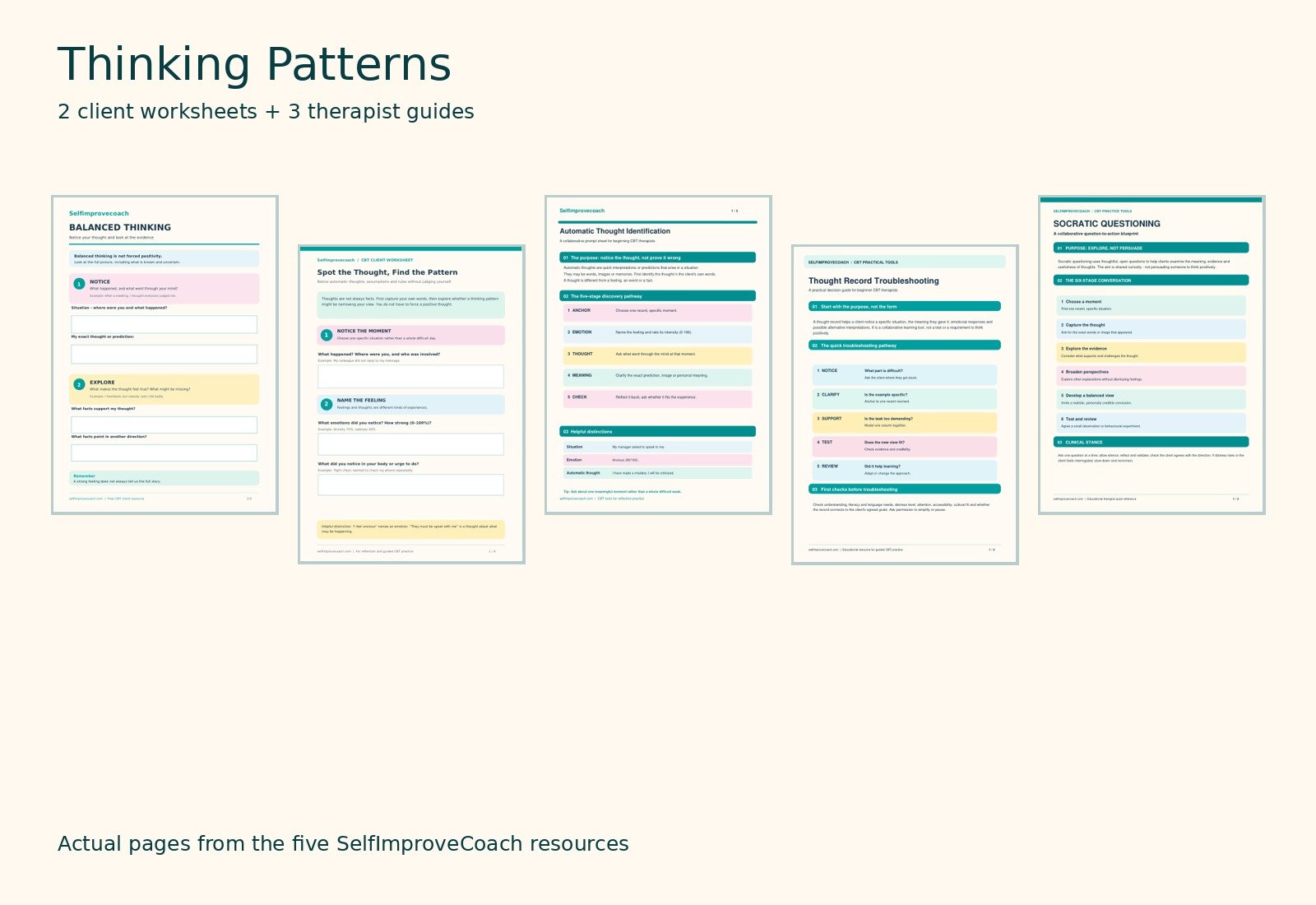
- Spot the Thought, Find the Pattern — a four-page fillable worksheet with examples, six thinking patterns and space to explore your own situation.
- Balanced Thinking — a three-page fillable worksheet for reviewing evidence, developing a believable perspective and reflecting on a small test.
Download the PDF and open it in a compatible PDF reader to enter and save your responses. Both worksheets can also be printed. If you prefer a shorter starting point, explore the existing Thought Record.
For therapists: keep the task collaborative
Match the resource to the client’s formulation, goals, language and accessibility needs. Work through a meaningful example together and check that any alternative perspective belongs to the client. You can use the Automatic Thought Identification prompt sheet, Socratic Questioning quick reference or Thought Record Troubleshooting guide; each is a three-page printable PDF.
When to pause
If writing becomes repetitive checking or increases distress, stop the exercise and consider whether a shorter conversation, practical action or a different approach would be more useful. Discuss persistent difficulties with your therapist or GP. These resources support education and reflection; they do not replace individual assessment or therapy.
Sources and further reading
Put an idea into practice
Explore worksheets and reflection tools for personal use and professional practice.
Browse free downloads →