

The conversation has finished, but your mind is still there. You are making tea or getting ready for bed when a sentence returns: “Why did I say that?” Soon you are reviewing your tone, the pause afterwards and whether the other person seemed different.
A little reflection can help us learn or put something right. Repeatedly examining the same uncertain moment can leave us feeling more tangled. If this sounds familiar, you do not need to solve every doubt before getting on with your evening. Start by noticing what the replay is asking you to do.
Why the conversation keeps coming back
Worrying after social situations can be part of social anxiety. The NHS describes anxiety before, during and after interactions; this alone does not mean you have a disorder. [1] Therapists sometimes call the detailed review of a social encounter post-event processing. NICE includes addressing problematic post-event processing within recommended CBT for social anxiety. [2]
One possible pattern is that you felt self-conscious during the conversation, watched yourself closely and then used that uncomfortable feeling to judge how it went. The Centre for Clinical Interventions explains that self-focused attention and scanning for signs of judgement can make neutral or positive information easier to miss. [3]
The review may promise an answer: “If I go over it once more, I will know whether I upset them.” But another replay cannot reliably reveal someone else’s private thoughts. Sometimes the question remains uncertain.
Reflection or rumination?
A useful distinction is what the thinking produces. Reflection might lead to a specific lesson: “I interrupted. Next time I will leave a little more space.” Rumination circles around broad judgements: “Why am I always awkward?”
This is a practical distinction, not a diagnostic test. Reflection can feel uncomfortable too. Ask: Am I learning something new, choosing a useful action, or going over the same doubts again?
The aim is not to ban reflection. It is to recognise when the review has stopped helping.
1. Name the replay without criticising yourself
Try a short description: “I am replaying the conversation.” You could add, “There is the worry that I came across badly.”
That wording leaves a little space between having a thought and accepting it as a conclusion. You do not need to replace it with a positive statement or repeat the phrase until you feel better. Notice the pattern, then consider what would be useful now.
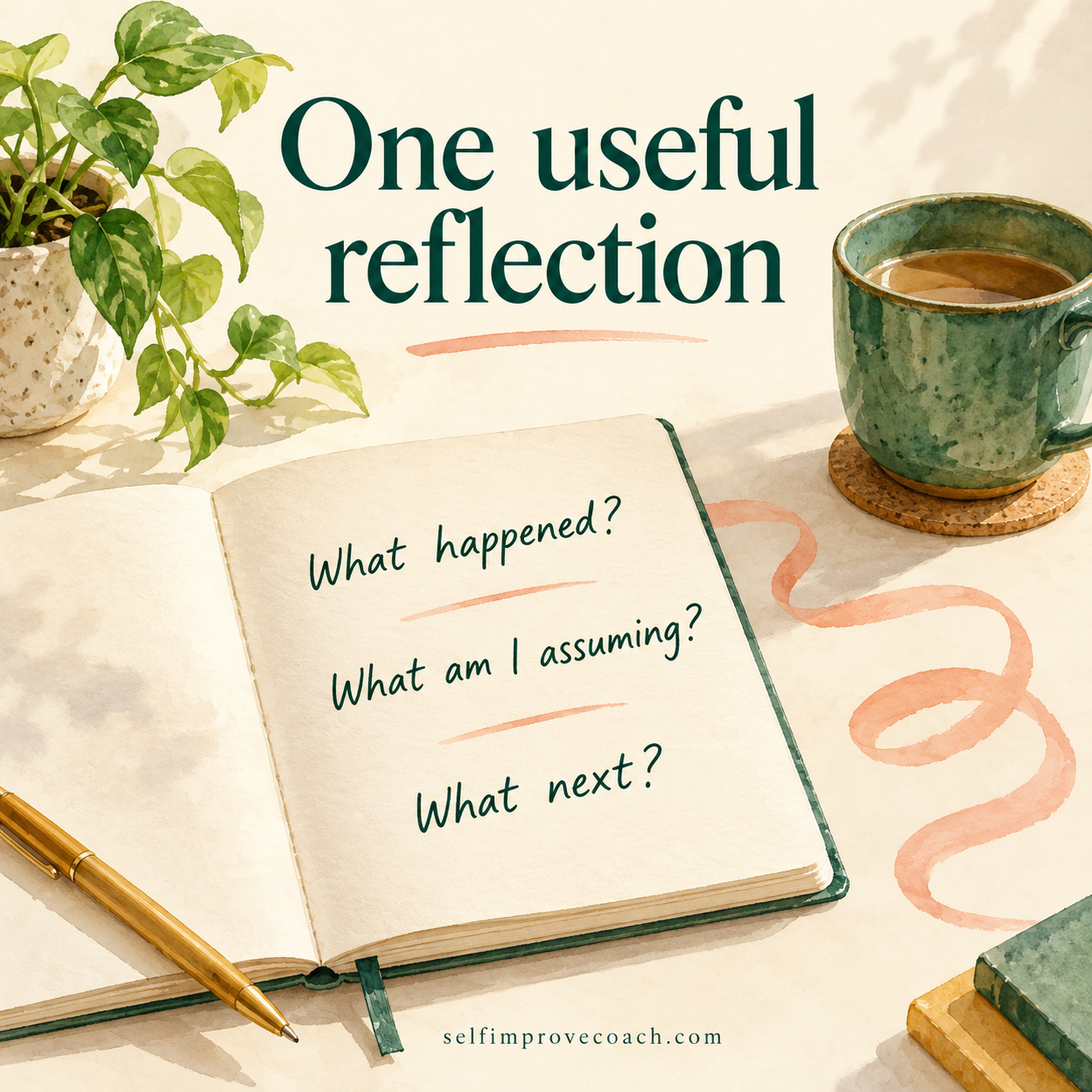
2. Separate what happened from what you are assuming
Take one moment rather than reconstructing the whole interaction. Use a brief note:
- What happened? “They looked at their phone while I was speaking.”
- What am I assuming? “They found me boring.”
- What remains unknown? “I do not know why they checked it.”
Other explanations may exist, but you do not have to prove a reassuring one. “I do not have enough information” can be an honest stopping point. If writing becomes another lengthy investigation, put the note down.
3. Choose one useful response
If there is a clear issue, choose a proportionate action. A brief clarification or apology may be appropriate when you know you gave incorrect information or hurt someone.
If the concern is a vague “What if they disliked me?”, another checking message may give only temporary relief. Consider whether you are communicating something useful or trying to obtain complete certainty.
CCI describes how the purpose of a behaviour matters when understanding anxiety: the same action can serve different functions. [4] Asking for support is not automatically unhelpful. The question is whether repeated checking is keeping you tied to the same doubt.
4. Return attention to what you are doing
Once you have chosen a response—or recognised that no action is needed—give the present activity some attention. If you are making tea, notice the kettle, cup and next part of the task. If you are with someone, return to what they are saying.
This is practice in choosing where attention goes, rather than a demand to make thoughts disappear. CCI recommends noticing wandering attention and bringing it back to the task. [3] During a conversation, that usually means engaging with the conversation, rather than monitoring yourself or searching faces for approval.
The replay may return. You can notice it and return again without starting the investigation from the beginning.
5. Keep the next conversation manageable
After an uncomfortable interaction, withdrawing can feel appealing. Where it is safe and appropriate, consider a small way to stay connected: greet a familiar person, ask a genuine question or share a brief opinion.
This is not a test of flawless performance. Afterwards, notice what you actually observed. Allow neutral information into the picture as well as anything difficult. Choose a step that fits your circumstances; support and adjustments may be needed too.
A small example
Sam leaves a meeting thinking, “My question sounded stupid.” They start rehearsing the moment, then notice they have returned to it several times.
Sam writes: “I asked for the deadline. My colleague answered. I felt embarrassed; I do not know what everyone thought.” There is no practical mistake to correct. Sam closes the note and returns to preparing dinner, even though some uncertainty remains.
This fictional example shows a different response to the replay. It does not promise that the worry will vanish immediately.
When extra support could help
If this pattern regularly disrupts sleep, leads you to avoid people or affects work and relationships, consider speaking with your GP or a qualified therapist. The NHS describes CBT and guided self-help among the available treatments for social anxiety. [1]
In England, you can also check the NHS talking therapies service finder. Access routes elsewhere in the UK vary.
For therapists: Explore the replay’s triggers, purpose and consequences collaboratively. Use the person’s formulation to distinguish useful review, safety behaviours, real interpersonal difficulties and support needs. A written exercise should support learning rather than become another demand to achieve certainty.
Choose one place to begin
Next time you notice a replay, try one question: “Is there a useful action here, or am I asking myself to solve uncertainty?”
For a little structure, explore SIC’s free CBT resources. You may also find noticing thoughts without having to control them and finding perspective when self-doubt takes over useful.
General education and reflection, not individual assessment or treatment advice. The example is fictional.
Sources and further reading
[1] NHS: Social anxiety (social phobia).
[2] NICE CG159: Recommendations, particularly 1.3.13.
[3] Centre for Clinical Interventions: The Role of Attention, Module 6.
[4] Centre for Clinical Interventions: Safety Behaviours, Module 5.
Sources checked 30 October 2026. The practical wording and fictional example are original educational applications, not a tested standalone treatment programme.
Put an idea into practice
Explore worksheets and reflection tools for personal use and professional practice.
Browse free downloads →
One Comment